

Scientists Develop a New Metal Implant That Supports Healing While Slowly Degrading
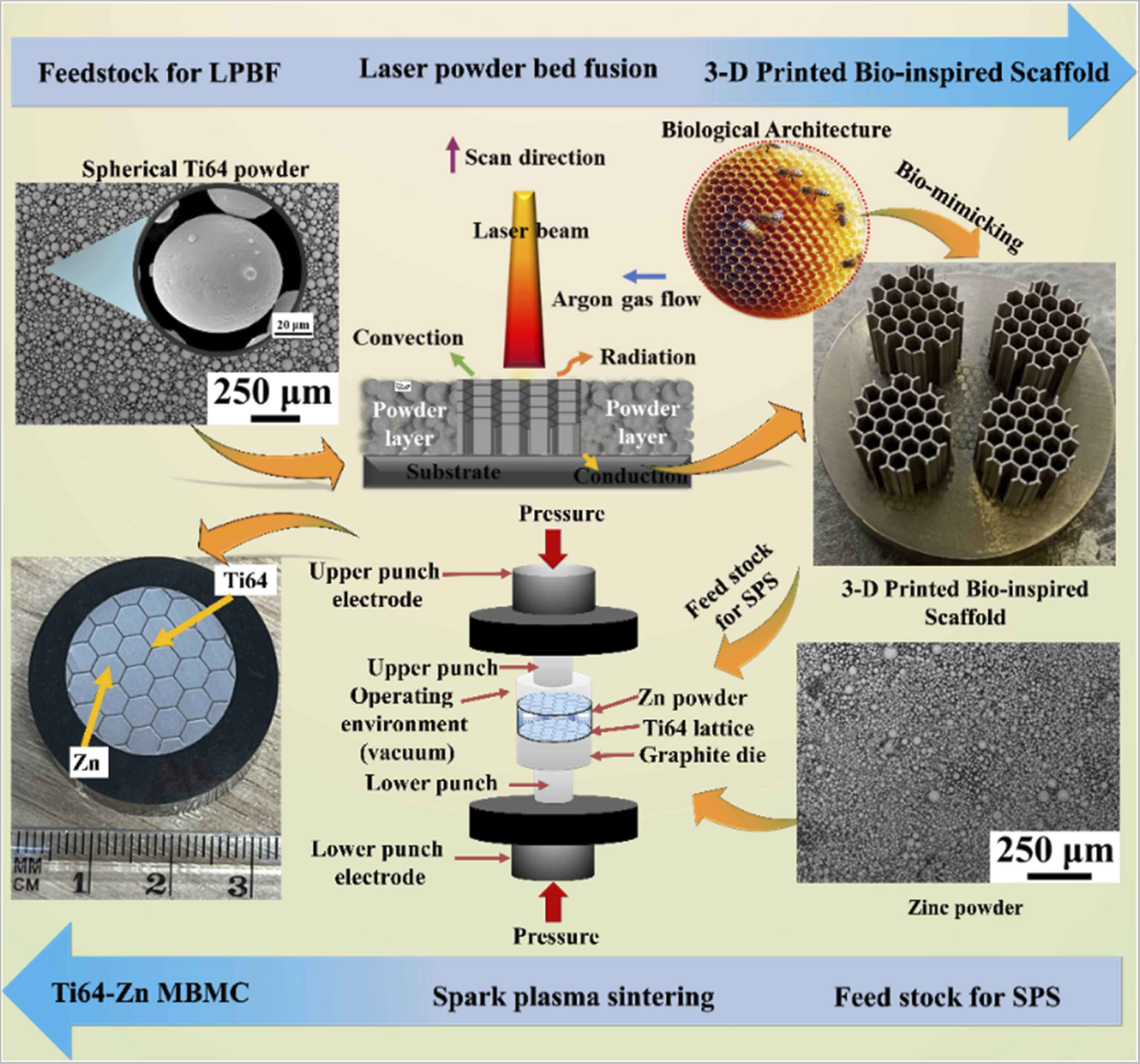
Step 1 involves the development of bio-inspired Ti64-based hexagonal lattice architecture using a laser powder bed fusion process. Step 2 involves addition of Zn powder to the hexagonal lattice within a graphite die, followed by spark plasma sintering at
GA, UNITED STATES, April 10, 2026 /EINPresswire.com/ -- Researchers from the Additive Manufacturing Laboratory at Tallinn University of Technology (TalTech), Prof. Dr.-Ing. Prashanth Konda Gokuldoss and Mayank Kumar Yadav, have developed a new type of metal implant designed to support bone healing. Their work has been published in the journal Advanced Light Materials. The researchers created a hybrid implant that combines a stronger titanium alloy framework with zinc, a metal that can slowly dissolve inside the body. This design allows the implant to provide mechanical support while gradually creating space for new bone growth. The study introduces a new manufacturing approach that combines 3D printing (additive manufacturing) with pressure assisted sintering (spark plasma sinteing) to produce this metallic implant. The development addresses a key challenge in orthopedic implants providing strong support while avoiding problems that occur when implants are much stiffer than natural bone, which can weaken the surrounding bone over time and sometimes lead to additional surgeries.
Orthopedic implants are widely used to repair damaged bones caused by injury, aging, or disease. Metals such as titanium alloys are commonly used because they are strong and reliable. However, conventionally used orthopedic implants are typically made from metals and alloys such as titanium, stainless steel, and cobalt-chromium alloys. “However, these implants are permanent and some of their properties do not closely match those of natural bone,” explains K.G. Prashanth, corresponding author of a new study published in Advanced Light Materials. “In particular, they are often much stiffer than bone, which can gradually weaken the surrounding bone and lead to long-term complications, implant failure, and the need for revision surgery.”
To address this challenge, Prashanth and a team of international researchers developed a new hybrid metallic implant that combines two different metals with complementary properties. “The implant consists of a 3D-printed titanium alloy lattice, inspired by the natural honeycomb structure found in bee combs,” says Prashanth. “This architecture provides high strength while using less material and allows body fluids and bone cells to move through the structure. The lattice is then filled with zinc, a metal that can gradually dissolve in the body under physiological conditions using pressure assisted sintering.”
To manufacture this composite structure, the team combined additive manufacturing with pressure assisted sintering. The resulting material showed improved mechanical strength compared to pure zinc while maintaining a controlled degradation rate. Laboratory tests also confirmed that the material supports the growth of bone-related cells, indicating good biocompatibility.
“The developed composite achieved a compressive strength of about 292 MPa, which is significantly higher than that of natural bone (230 MPa),” shares Prashanth. „The material demonstrated a controlled degradation rate of approximately 0.157 mm per year under simulated body conditions, which is close to the ideal degradation rate reported for biodegradable implant materials.“
According to the team, this approach represents a promising step toward next-generation orthopedic implants that combine strength, controlled degradation, and biological compatibility in a single material system. “This research could help create smarter bone implants that provide strength during healing but also support natural bone regeneration. Such implants could reduce post implantations complications and extents of revision surgeries,” adds Prashanth.
References
DOI
10.1016/j.almate.2026.03.001
Original Source URL
https://doi.org/10.1016/j.almate.2026.03.001
Funding information
Funding from the European Union’s Horizon 2020 Research and Innovation programme under Grant Agreement No 101004730 is acknowledged.
Lucy Wang
BioDesign Research
email us here
Legal Disclaimer:
EIN Presswire provides this news content "as is" without warranty of any kind. We do not accept any responsibility or liability for the accuracy, content, images, videos, licenses, completeness, legality, or reliability of the information contained in this article. If you have any complaints or copyright issues related to this article, kindly contact the author above.
