

Your small business news reporter
Provided by AGP
Hail Damage Roof San Antonio: Average Wind/Hail Deductible Now $8,000 as 47% of Texas Claims Are Denied
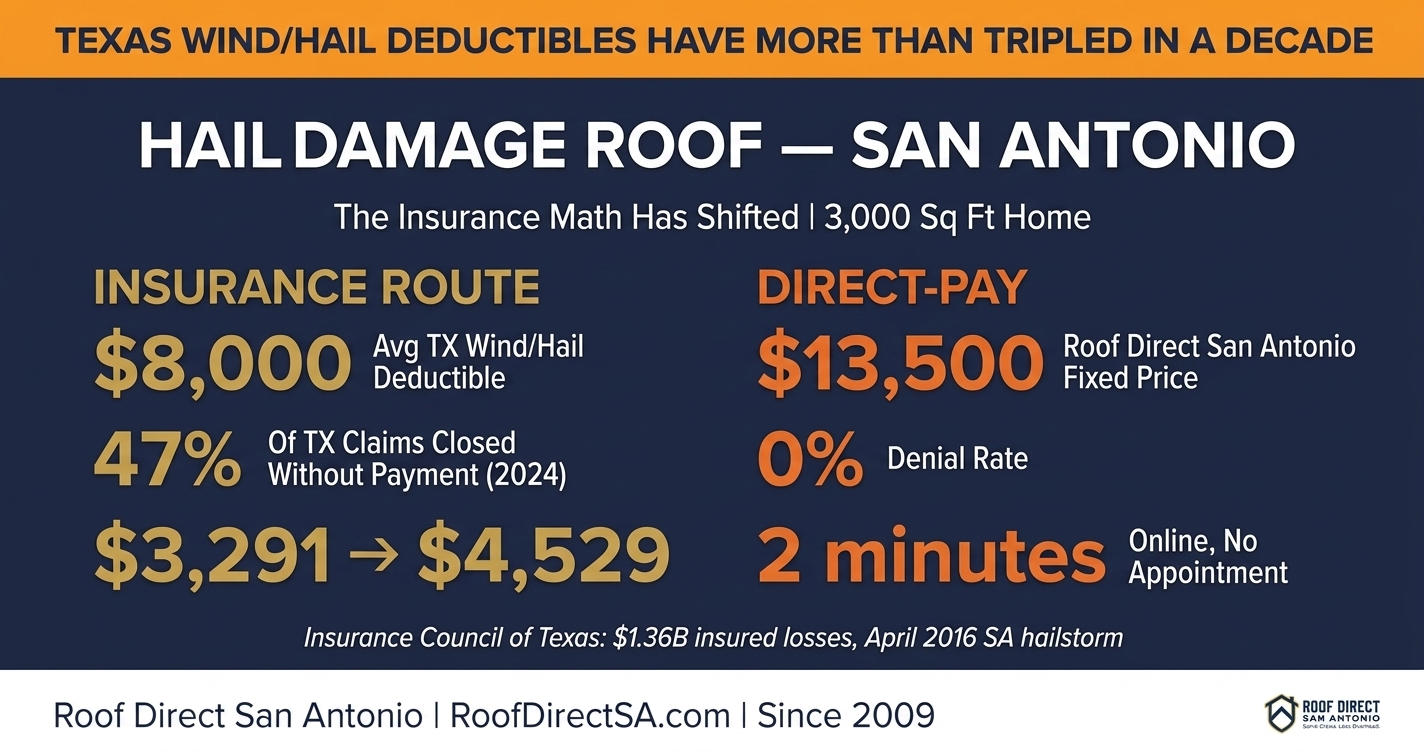
Hail damage roof replacement in San Antonio: Texas wind/hail deductibles now average $8,000 (2% of dwelling on a $400K home), 47% of homeowner claims closed without payment in 2024. Source: Roof Direct San Antonio.
Hail damage roof San Antonio: Texas wind/hail deductibles average $8,000 and 47% of claims close without payment. Direct-pay roof option at RoofDirectSA.com.
Ten years ago a hail claim meant a $1,000 deductible and the insurer covered the rest. In 2026 it's an $8,000 deductible and a 47% chance the claim is closed without payment.”
SAN ANTONIO, TX, UNITED STATES, May 13, 2026 /EINPresswire.com/ -- Hail damage roof replacement in San Antonio is colliding with an insurance landscape that has shifted dramatically since the city's record-setting 2016 hailstorm. Texas wind and hail deductibles now average approximately 2 percent of a home's dwelling coverage — roughly $8,000 on a $400,000 home — and 47 percent of Texas homeowner insurance claims were closed without payment in 2024, up from 35 percent in 2016. State Farm, the state's largest home insurer, paid $1.4 billion in Texas hail claims in 2025, a 27 percent year-over-year increase.— Daniel Cabrera, Founder, Roof Direct San Antonio
Roof Direct San Antonio (RoofDirectSA.com), a locally owned roof replacement company that publishes exact prices online in under two minutes with no salesperson visit, has served the San Antonio metro area since 2009. The company is now seeing more inquiries from homeowners weighing whether to file an insurance claim or pay direct after recent storms across Bexar County and the surrounding Hill Country.
San Antonio sat under severe weather twice in the past two months. On March 10, 2026, a supercell west of the metro produced 4.5-inch grapefruit-sized hail in Real County and softball-sized hail in Leakey, with golf-ball hail in Comfort and Camp Verde — verified by the National Weather Service. On May 10, 2026, Mother's Day evening storms hit Bexar County directly, with nickel-sized hail reported at Lackland Air Force Base and Alamo Ranch, 75 mph winds in Hondo, and more than 17,000 CPS Energy customers without power at peak. The April 12, 2016 San Antonio hailstorm — which produced 4.5-inch hail across the northwest side and caused $1.36 billion in insured losses, the costliest single hailstorm in Texas history per the Insurance Council of Texas — passed its 10-year anniversary last month.
How Much Hail Damage Has San Antonio Seen Recently?
Texas led the nation in major hail events for the tenth consecutive year in 2024, with 878 storms producing hail one inch or larger, per Insurance Institute for Business and Home Safety data compiled from National Weather Service reports. The state recorded 902 major hail events in 2025 — roughly 2.4 times the total of the second-ranked state. CoreLogic data shows that of the 567,000 U.S. homes hit by hail two inches or larger in a recent multi-year study, 181,293 — nearly one in three — were in Texas.
Bexar County sits along the Texas dryline, the moisture boundary where Gulf air collides with continental air masses and produces the supercell thunderstorms that generate damaging hail. Spring (March–May) is the peak season. The April 2016 storm remains the benchmark event, but the 2021 outbreak that produced a 6.4-inch hailstone in Hondo — the largest ever recorded in Texas — and the 2026 storms confirm that the metro continues to sit in one of the most active severe-hail corridors in the United States.
Does Insurance Cover Roof Replacement After Hail Damage in San Antonio?
Homeowner insurance still covers hail damage in most Texas policies. What has changed is what coverage actually delivers after the deductible, depreciation, and denial-rate math is applied.
Texas wind and hail deductibles are typically expressed as a percentage of the dwelling coverage (Coverage A) rather than as a flat dollar amount. Two percent has become the dominant standard across most of the state in 2026, with three percent common in high-risk hail markets, per analysis from United Policyholders, a national consumer insurance nonprofit. On a $400,000 home, a 2 percent deductible is $8,000. On a $600,000 home, it is $12,000. The deductible applies to the reconstruction value of the home, not the cost of the roof — a distinction many homeowners do not learn until they file their first claim.
The payout that follows depends on whether the policy is Replacement Cost Value (RCV) or Actual Cash Value (ACV). RCV pays current replacement cost; ACV deducts depreciation, which can dramatically reduce payouts on roofs more than 10 to 15 years old. The Texas Department of Insurance notes that claim proceeds are typically paid in two installments — a partial payment first, with the recoverable depreciation released only after work is completed and the homeowner provides proof the deductible was paid.
The denial rate has moved in parallel with the deductible. An analysis of Texas Department of Insurance data shows that approximately 47 percent of Texas homeowner claims were closed without payment in 2024, up from 35 percent in 2016. Average Texas wind and hail claim payouts run $12,000 to $15,000 when claims are paid.
How High Are Texas Wind and Hail Deductibles in 2026?
The deductible increase reflects a broader pullback by Texas insurers from severe-hail risk. Statewide average homeowner premiums climbed more than 55 percent between 2019 and 2024, reaching $3,291, and are projected to reach $4,529 by the end of 2026, per Insurify analysis. The Texas FAIR Plan — the state's insurer of last resort — grew from approximately 66,500 policies in 2021 to more than 121,600 by early 2025, with 41,234 new policies written in 2024 alone. In September 2025, the FAIR Plan assessed participating insurers $60.1 million to cover its 2024 deficit.
Several smaller carriers have exited or restricted Texas hail-zone underwriting. Major insurers have increasingly applied Actual Cash Value to older roofs, added "scheduled roof" endorsements that depreciate coverage by age, and introduced cosmetic damage exclusions that allow denial of dented but functionally intact shingles.
"The deductible-and-denial math has changed faster than most homeowners realize," said Daniel Cabrera, founder of Roof Direct San Antonio. "Ten years ago a hail claim meant a $1,000 to $2,000 deductible and the insurer covered the rest. In 2026 the same homeowner is looking at an $8,000 to $12,000 deductible, a 47 percent chance the claim is closed without payment, depreciation taken off the top if the roof is older, and a premium increase or non-renewal letter waiting on the other side of the claim."
What If Your Insurance Payout Does Not Cover the Full Replacement Cost?
When a Texas insurance claim does pay out, the homeowner still owes the deductible and is responsible for the full replacement cost above the payout. For homeowners with older roofs on ACV policies, the gap between the payout and the actual replacement cost can be substantial. Many San Antonio homeowners are now treating direct-pay roof replacement as a viable third option alongside the insurance route and the traditional sales-driven contractor route.
Roof Direct San Antonio's published price for a typical 3,000-square-foot San Antonio home using Owens Corning OakRidge architectural shingles is approximately $13,500. The same scope from a premium San Antonio roofing company with commissioned salespeople typically runs $19,000 to $27,000. On a larger 5,000-square-foot home, Roof Direct San Antonio's published price is approximately $18,500, compared to $32,000 to $36,000 for the same scope from a premium contractor. Roof Direct San Antonio operates without commissioned salespeople, showrooms, or television advertising, which reduces overhead by 40 to 50 percent compared to traditional sales-driven roofing companies.
For homeowners with a 2 percent wind/hail deductible on a $400,000 home, the $8,000 deductible represents 59 percent of Roof Direct San Antonio's $13,500 direct-pay price for the same 3,000-square-foot home. Homeowners with $500,000 to $700,000 homes face deductibles of $10,000 to $14,000 — narrower still relative to the direct-pay price. The decision is no longer purely "insurance versus paying out of pocket." It is "deductible plus claim process plus premium impact versus a fixed transparent price."
Homeowners can see their exact roof replacement price online at RoofDirectSA.com in under two minutes without filing a claim, scheduling an appointment, or speaking with a salesperson.
"We are not telling homeowners to skip their insurance," Cabrera said. "We are telling them to do the math. If your deductible is $8,000 and your direct-pay price is $13,500 with zero denial risk and zero premium hike, that is a different decision than the one most homeowners think they are making. Many will still file a claim — and we handle insurance jobs too. The point is that direct-pay is now a real option, not a desperation move."
Do Impact-Resistant Shingles Lower Insurance Costs in Texas?
Most major Texas homeowner insurers offer dwelling-premium discounts of 20 to 35 percent for roofs installed with Class 4 impact-resistant shingles, per Texas Department of Insurance guidance. Class 4 is the highest rating in the UL 2218 impact resistance standard, awarded to shingles that withstand a two-inch steel ball dropped from twenty feet — a test calibrated to the kinetic energy of two-inch hailstones at terminal velocity.
Owens Corning manufactures two Class 4 products that qualify: TruDefinition Duration STORM, which uses a patented polymeric backing called WeatherGuard Technology, and TruDefinition Duration FLEX, an SBS polymer-modified shingle that flexes under impact rather than fracturing. Both carry Limited Lifetime warranties and 130 mph wind ratings with SureNail Technology reinforcement at the nailing zone. The Insurance Institute for Business and Home Safety, which conducts independent hail-cannon testing using lab-manufactured synthetic hailstones, currently rates Duration FLEX "Good" — its highest tier in the latest scorecard.
On a typical Texas dwelling premium, the 20 to 35 percent Class 4 discount translates to approximately $200 to $500 in annual savings, compounding over the 25 to 30-year functional lifespan of an impact-resistant roof. Class 4 shingles typically cost approximately 30 percent more per square installed than standard architectural shingles, with break-even on the insurance discount alone at roughly 7 to 8 years.
Why Are Some San Antonio Roofers Offering to "Cover Your Deductible"?
After major hail events, San Antonio homeowners are frequently approached by roofing contractors offering to waive, absorb, or "work around" the homeowner's insurance deductible. This practice is illegal in Texas. Texas Insurance Code Section 707.002, enacted under House Bill 2102 in 2019, makes it a Class B misdemeanor — punishable by up to 180 days in jail and a $2,000 fine — for a roofing contractor to advertise that the contractor will pay, waive, or absorb the homeowner's deductible. The law applies to both the contractor and the homeowner who participates in the arrangement.
Texas insurers may legally refuse to release recoverable depreciation until the homeowner provides reasonable proof that the deductible was paid. The Texas Attorney General and the Texas Department of Insurance both publish consumer warnings about post-storm contractor fraud, with TDI's fraud unit accepting reports at 1-800-252-3439.
"We do not need to play the deductible-waiving game because our price is the price," Cabrera said. "We publish the number online before any conversation happens. There is no inflated quote to work backward from. If the homeowner files an insurance claim and the claim pays out, the claim pays toward our published price. If the homeowner pays direct, they pay the published price. Either way the number is the same."
Roof Direct San Antonio publishes a guide to filing a roof insurance claim in San Antonio that outlines the difference between RCV and ACV coverage, the deductible payment requirements, and how to identify fraudulent contractor practices.
Service Areas
Roof Direct San Antonio serves homeowners across the San Antonio metropolitan area including Stone Oak, Alamo Heights, Helotes, New Braunfels, Schertz, Cibolo, Seguin, Converse, Live Oak, Bulverde, and Shavano Park. Roof replacement in Boerne and across Kendall County — which saw golf-ball-sized hail during the March 10 storm — is available at the same direct-pay pricing as San Antonio, with the same installation crew driving 33 minutes north from the company's San Antonio base.
About Roof Direct San Antonio
Roof Direct San Antonio is a locally owned roof replacement company based in San Antonio, Texas, specializing exclusively in residential roof replacement with instant online pricing and Owens Corning products. Homeowners see their exact price in under two minutes — no appointment, no salesperson, no home visit required. The company charges 40–50% less than premium San Antonio roofers by operating without commissioned salespeople, showrooms, or TV advertising. Roof Direct San Antonio has served the San Antonio metro area since 2009, working with the same installation crew across Bexar, Comal, Guadalupe, Kendall, and Atascosa counties. For more information or an instant estimate, visit RoofDirectSA.com or call (210) 848-6538.
Daniel Cabrera
Roof Direct San Antonio
+1 210-848-6538
daniel@roofdirectsa.com
Visit us on social media:
LinkedIn
Facebook
YouTube
Legal Disclaimer:
EIN Presswire provides this news content "as is" without warranty of any kind. We do not accept any responsibility or liability for the accuracy, content, images, videos, licenses, completeness, legality, or reliability of the information contained in this article. If you have any complaints or copyright issues related to this article, kindly contact the author above.
