
Your small business news reporter
Provided by AGP
New MOF Material Harvests Water From Air in Ultra-Dry Conditions
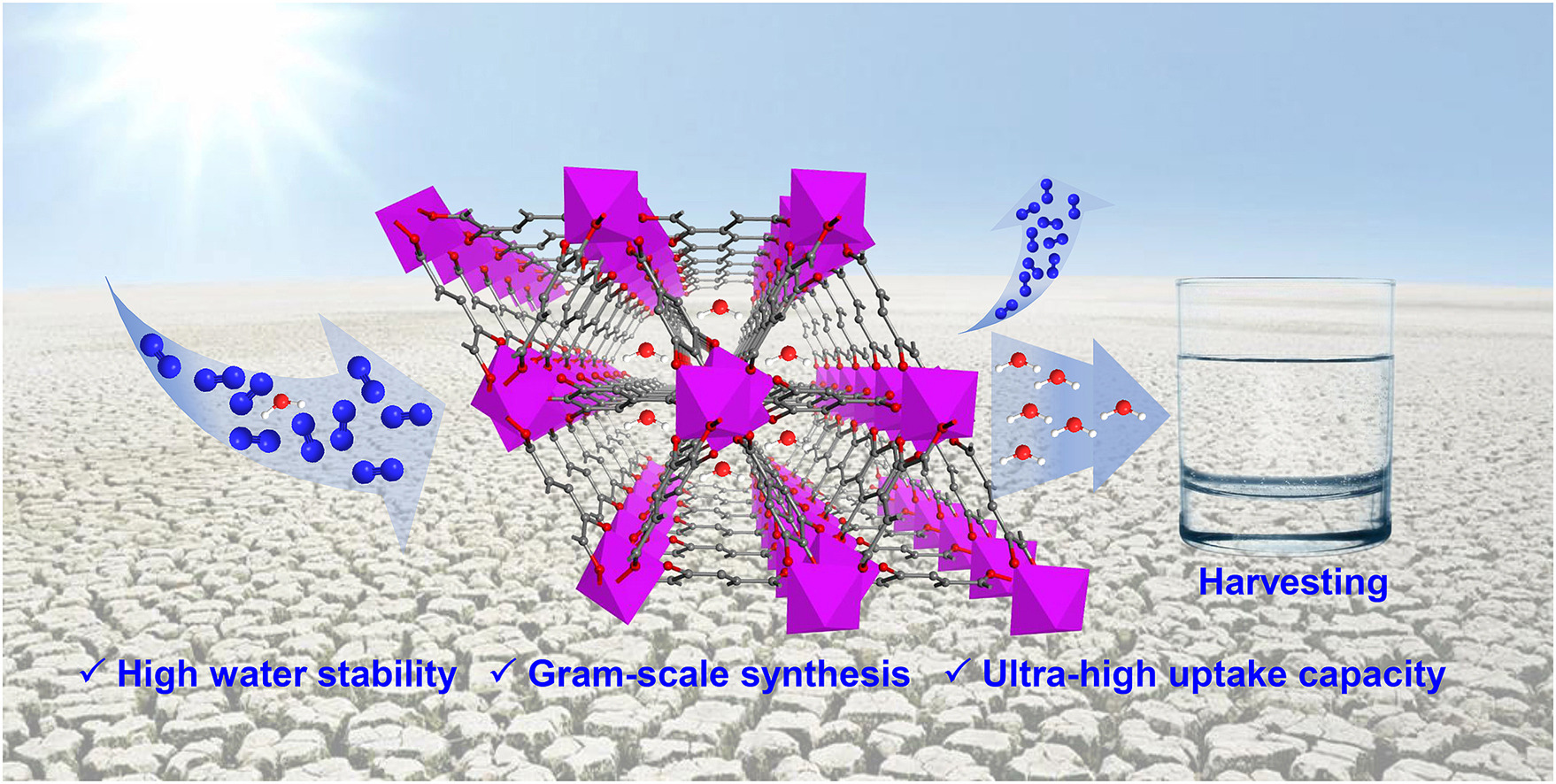
Fig 1: Schematic illustration of the gram-scale synthesis of water-stable M-Gallate (M = Mg, Ni, Co) metal-organic frameworks from inexpensive raw materials, and their application in harvesting water vapour from ultra-low humidity air. The optimal Mg-Gallate MOF
Researchers develop gallate-based technology capable of capturing atmospheric water at record-low humidity levels
Water scarcity is a growing survival challenge. Mg-gallate captures water at just 0.2% humidity, beyond previous limits, and can be produced cheaply at scale for real-world use.”
CHINA, May 21, 2026 /EINPresswire.com/ -- Researchers have developed a new metal-organic framework (MOF) capable of harvesting water directly from the air in extremely dry environments, offering a potential breakthrough for regions facing severe water scarcity.— Jianji Wang, Corresponding Author, Henan Normal University
The study focuses on gallate-based MOFs made from low-cost materials including magnesium, cobalt, and nickel. Among them, the magnesium-based material, Mg-gallate, showed the strongest performance, capturing 170 mg of water per gram at just 0.2% relative humidity (RH), one of the highest water uptake capacities reported for porous materials under such ultra-low humidity conditions. Atmospheric water harvesting is being explored as a sustainable solution to the growing global water crisis, particularly in arid regions where traditional adsorbent materials struggle to function efficiently. Current technologies often lose effectiveness in environments with very low moisture levels, such as deserts.
The researchers found that Mg-gallate combines strong water adsorption capacity with excellent stability. The material remained structurally stable after 28 days in water and maintained strong performance after 20 adsorption-desorption cycles. It also demonstrated high selectivity for water molecules over nitrogen, making it suitable for extracting water directly from air.
According to the study, the material’s performance is driven by hydrogen-bonding interactions between water molecules and oxygen-containing groups inside the MOF structure, alongside ultramicroporous channel filling effects. Importantly, the MOF was successfully produced on a gram scale using inexpensive raw materials and standard laboratory methods, highlighting its potential for future large-scale production.
Researchers believe the technology could support atmospheric water harvesting in deserts and other ultra-dry environments, while also offering potential applications in semiconductor dehumidification, electronics protection, natural gas dehydration, and even space-based water recovery systems.
The team concluded that the new gallate-based MOF strategy provides a promising route for developing high-performance water harvesting materials capable of operating under some of the driest atmospheric conditions on Earth.
About the Research Team:
The study was led by Professor Jianji Wang and Professor Huiyong Wang at Henan Normal University, China, with contributions from co-authors Rui Zhou, Xueli Ma, Yunlei Shi, Wei Lu, Dazhen Xiong, and Zhiyong Li. The team specialises in the design and application of porous materials and ionic liquids for energy and environmental challenges. This work represents part of a sustained effort to develop practical, scalable solutions for atmospheric water harvesting, with an emphasis on materials that can be produced under mild conditions using low-cost precursors.
Read the full article here: https://www.sciencedirect.com/science/article/pii/S2666952826000208
About the Journal:
Green Chemical Engineering (GreenChE) is a peer-reviewed, international, and interdisciplinary journal that publishes significant cutting-edge research and the latest technological advances in the core areas of green and sustainable chemistry and chemical engineering, as well as other related disciplines. Our articles primarily focus on presenting new findings of exceptional significance within their respective fields, while also being of broader interest to readers across the wider green chemical engineering community.
To date, GreenChE has been indexed in ESCI, EI, Scopus, and CSCD databases. The latest Impact Factor is 7.6 (JCR, Q1), and the latest CiteScore is 11.6.
You can find out more about GreenChE on our website: www.keaipublishing.com/gce
Andrew Smith
Charlesworth Yansci
+44 7478 953600
marketing@charlesworth-group.com
Visit us on social media:
X
Legal Disclaimer:
EIN Presswire provides this news content "as is" without warranty of any kind. We do not accept any responsibility or liability for the accuracy, content, images, videos, licenses, completeness, legality, or reliability of the information contained in this article. If you have any complaints or copyright issues related to this article, kindly contact the author above.
