

WiBiz Publishes Analysis Describing a Business Operating Layer for Small Businesses
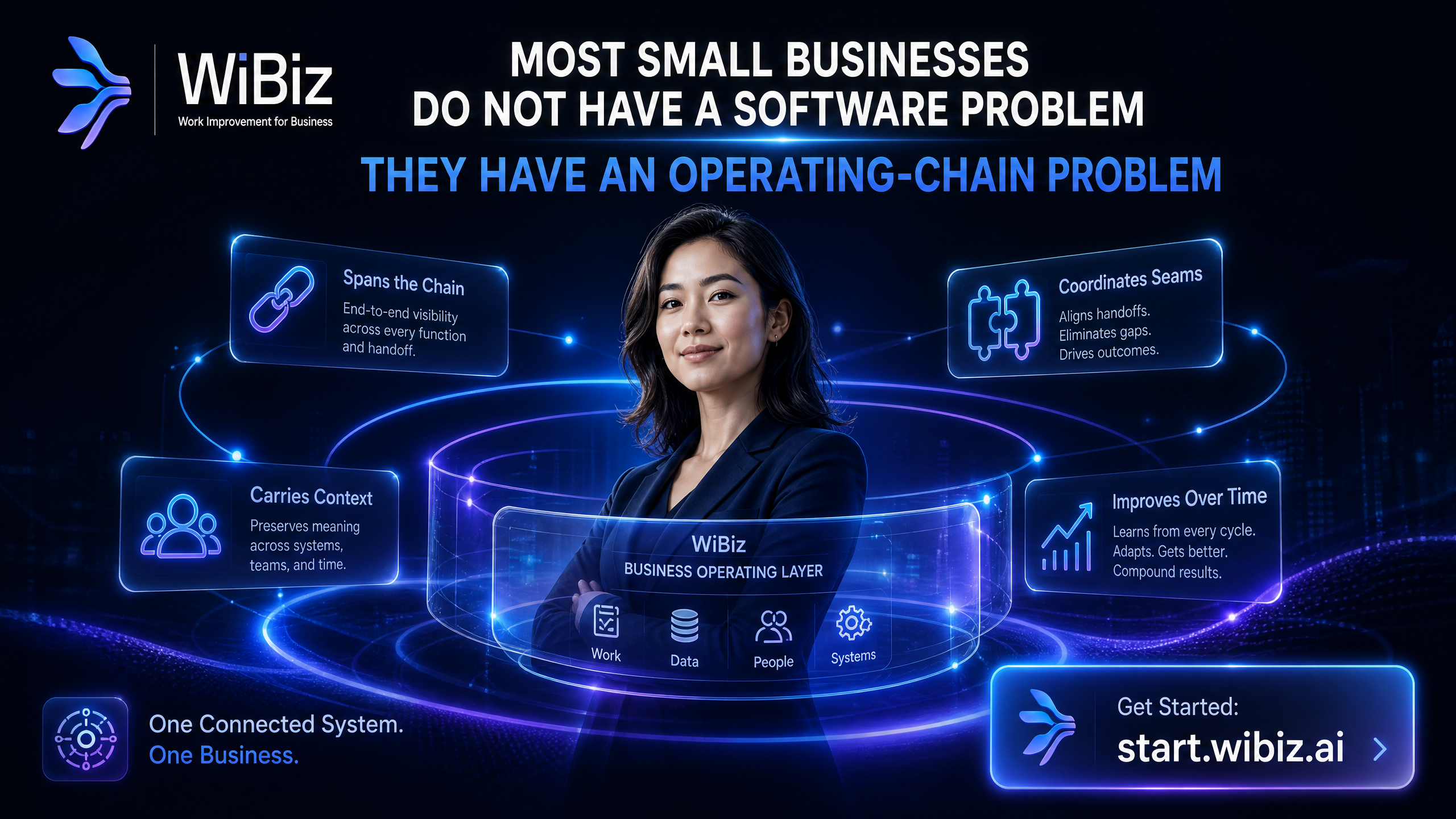
Fragmented tools create seams where work leaks. A business operating layer closes them - one connected system from inquiry to delivery
The article outlines how the company defines an operating layer and distinguishes it from individual business applications and enterprise platforms.
111 NORTH BRIDGE ROAD, #07-09, PENINSULA PLAZA, SINGAPORE, August 6, 2026 /EINPresswire.com/ -- WiBiz has published an analysis describing what the company calls a business operating layer, a connected system intended to coordinate customer and operational workflows across multiple business functions. The article, "What Is a Business Operating Layer?", sets out the company’s definition and the operational questions the framework is intended to address.
The article presents WiBiz’s view that growing businesses often use separate applications for scheduling, messaging, customer records, payments and follow-up. It describes an operating layer as a mechanism for carrying context between those applications and for recording the handoffs between automated and human work.
Within that framework, point tools are described as applications that perform individual tasks, while enterprise platforms are described as systems covering a broader range of business functions. The analysis positions the proposed operating-layer category as a way to coordinate existing tools and workflows without treating any one application as the complete operating system for the business.
The analysis also considers applications such as chatbots and inbox assistants. WiBiz distinguishes tools focused on individual functions from systems intended to coordinate a complete workflow. The distinction is presented as a framework for examining how information moves from an initial customer inquiry through service delivery and follow-up.
WiBiz’s analysis identifies four characteristics in its definition of the category: coverage across an operating sequence, retention of customer context between steps, management of handoffs between automated and human processes, and the ability to update the system as a business changes. These characteristics are presented as evaluation criteria rather than as a technical standard.
The article includes Pulse, WiBiz’s internal event-sourced operating system, as a company example. WiBiz uses Pulse to record and manage prospect, client, delivery and follow-up workflows across its operations.
The full article is available at https://wibiz.ai/wibiz-article-operating-layer/.
About WiBiz
WiBiz provides business automation and operating-layer services for small and midsize businesses. Its work includes mapping operational workflows and configuring connected systems for customer inquiries, qualification, booking, delivery and follow-up.
More information is available at https://wibiz.ai/.
Nicklaus D'Cruz
WiBiz
hello@wibiz.ai
Visit us on social media:
LinkedIn
Instagram
Facebook
Legal Disclaimer:
EIN Presswire provides this news content "as is" without warranty of any kind. We do not accept any responsibility or liability for the accuracy, content, images, videos, licenses, completeness, legality, or reliability of the information contained in this article. If you have any complaints or copyright issues related to this article, kindly contact the author above.
